The boat is wider than it looks from the shore.
That was the first thing I noticed. The second was that I had no idea what I was doing. The third was that nobody else cared, and that everyone was pleased I had come.
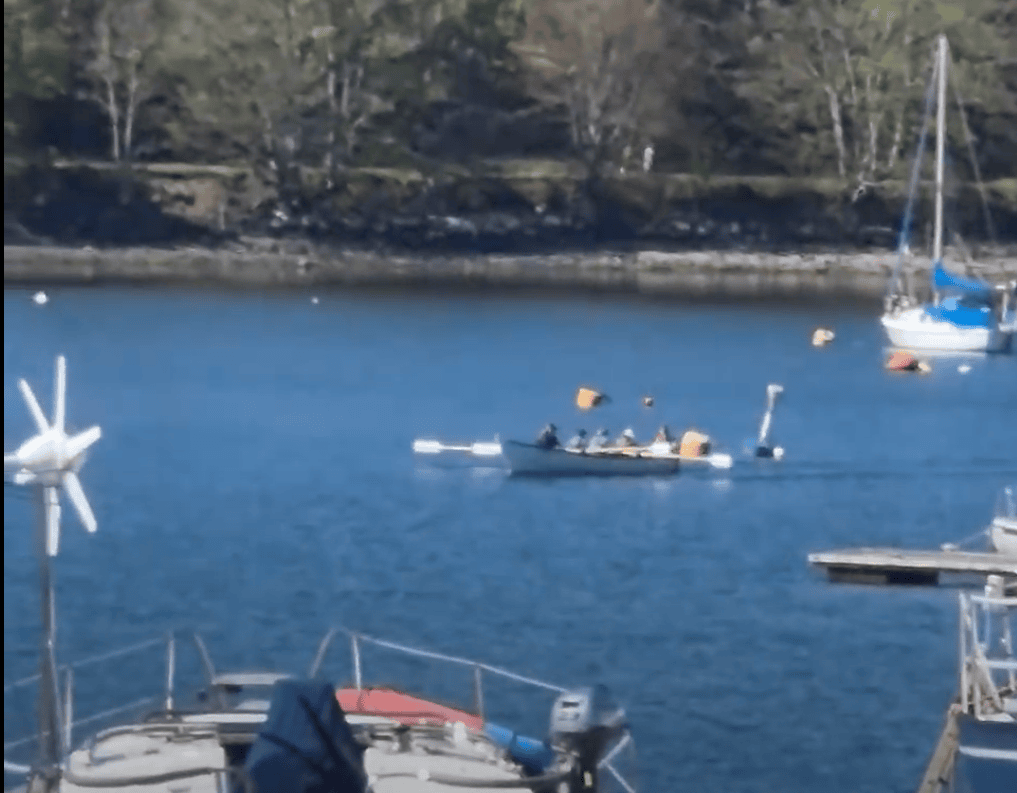
This was a Sunday afternoon in late April. Dunstaffnage. I had decided, the previous week, to go rowing. I had never rowed in my life. I did not know how the oars worked, how the boat balanced, how the rhythm was kept, who shouted what at whom. I knew two people at the club — Andreas and Lyle, both from the Gaelic community — and beyond that I knew nothing and nobody.
I went anyway.
Here is the part that is easy to miss in a coaching story. I didn’t want to go.
I wanted to want to go. I had told myself, in advance, that this was the kind of thing I should be doing now — getting out, meeting people, planting myself in the community properly, four years into living in Argyll. I had even told other people I was going to do it, which is one of the older tricks in the book for making yourself do a thing.
But on the actual Sunday, when the actual moment came to put on the actual jacket and drive to the actual rowing club, I did not want to go.
I went anyway.
This is the part of the saying-yes story that nobody mentions on the inspirational poster. The yes is not a feeling. The yes is a decision you make in spite of the feeling. The feeling, very often, is that you would prefer to stay indoors with the dog and the kettle and the laptop. The yes is what you do despite that.
What happened at the club is — almost embarrassingly — exactly what every encouraging coach in every encouraging book says will happen.
People were friendly. Nobody minded that I didn’t know what I was doing. Lyle remembered me from years back in Falkirk, where he had been one of my Gaelic students, and was now a Mòd gold medallist. Andreas, who had interviewed me years ago for BBC Alba during the Commonwealth Games, asked how the move to Argyll was going. The club secretary made sure I had what I needed. I got in a boat. We went out on the water.
I did most things wrong. I was told what to fix, gently, and I fixed it, mostly. The boat moved. The coastline went past. I made it back to the slip without incident, which on a first session is the only success criterion that actually matters.
And on the drive home, I caught myself doing something I had not done in a very long time. I was already planning the next thing.
Here is what I think is true about saying yes to the uncomfortable thing.
It is not really about the thing.
It is about the version of you that exists after you have done it. The version who knows, from inside experience rather than from the outside imagining of it, that the boat is wider than it looks. That nobody is watching as closely as you fear. That the people who are already in the room are usually pleased to see one more person walk through the door. That the discomfort burns off about twenty minutes in, replaced by something quieter and more interesting.
You don’t get to that version of yourself by thinking about it. You don’t get there by reading about other people who got there. You don’t get there by waiting until you feel more ready, because the readiness is on the other side of the doing, not this side.
The only way through is through.
I am not naturally a club joiner. I have built things — communities, networks, campaigns, language groups — but always from the originating side, where I was the one extending the invitation. Walking into a room as the new person, where the rhythm is already established and the friendships are already in place, is a different kind of work.
It is, in fact, the harder kind. The originating part comes more naturally because you are setting the terms. The joining part requires you to accept terms set by others — to be, for an afternoon, the person who doesn’t know which oar is which.
A lot of coaching clients describe their version of this. They are usually competent, often senior, frequently the person other people come to. The uncomfortable thing for them is not always the big leap — the career change, the difficult conversation, the move. Sometimes it is the small specific thing of walking into a room where they will, for a moment, not be the expert. The room where they have to be a beginner again, in public.
The harder the room is to walk into, the more it is probably worth walking into.
What is the boat you have not got into yet?
What is the room you have been telling yourself you’ll join when life is a bit less busy, when you’ve got the right kit, when you know somebody who’s already going?
The terms you are setting for yourself are almost certainly stricter than the terms the room is setting for you. The room is mostly just hoping someone new turns up.
Be the someone.
Is obair làtha toiseachadh. A beginning is a good day’s work.
Jamie Wallace is a professional coach and the founder of Colmcille Coaching, based in Argyll. He writes about transitions, the active form of resilience, and what Celtic wisdom and modern coaching practice can teach each other.