Leadership & Work
The Question Someone Asked at a Conference That Changed Everything
29 May 2026 · Jamie Wallace · gaelic · community-building · clydesdale · originating
There is a moment, somewhere in autumn 2013, that I can almost picture exactly. A conference. A corridor between sessions, or a coffee break, or the foyer — I don’t fully remember the setting. What I remember is the question.
Could you set up Gaelic lessons in Clydesdale?
I said yes.
I did not know how. I had no committee. No funding. No venue. No classes. No students. No syllabus. No experience as a Gaelic tutor. I had a developing Gaelic of my own, two years in, and a belief that the language belonged in places it was not yet being taught. The person asking the question wasn’t offering me a job. They were testing an idea. I said yes anyway.
What happened next is the post.
Within weeks there was a committee. Then a funding application to Bòrd na Gàidhlig. Then a budget. Then a venue — Carluke Lifestyles, Carnwath Road, Carluke. Then a class. Three pilot sessions on Wednesday evenings in November and December 2013, seven students, then six, then seven again. I caught the train from Glasgow Central each Wednesday evening, taught the class, caught the 22:37 back to Pollokshaws. Work undertaken because it needed doing.
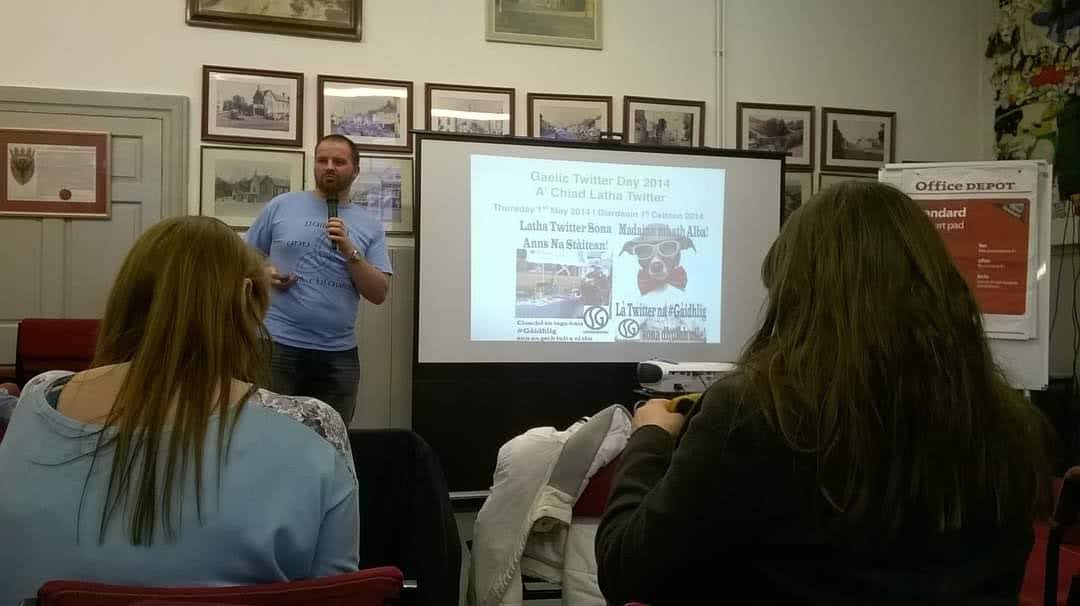
Then a second cohort. Then a workbook I wrote from scratch — Level 1, aligned to the Common European Framework of Reference for Languages, colour-coded learning outcomes across all four skills, a grammar guide covering lenition and the vocative case and the absence of yes and no in Gaelic. Then a Moodle platform I built from scratch so students could review the material between sessions. Then I helped with the organising of a public open day in Lanark — waulking group performances, a history talk, “Speak Gaelic in Ten Minutes,” my presentation on Gaelic Twitter Day. I even coined a name for what we were doing: Community Gaelic, distinct from formal academic study.
Three years from that corridor conversation, the Clydesdale Gaelic Initiative — Iomairt Gàidhlig Dail Chluaidh — was a fully functioning community Gaelic programme. Students who could not previously order coffee in Gaelic were holding short conversations in it. A village in South Lanarkshire that had no Gaelic infrastructure in 2013 had one by 2016.
It started with one question, in a corridor, that I said yes to before I knew how.
Here is what is true about saying yes before you know how.
It is not the same as being reckless. It is not the same as overpromising. It is not the same as winging it.
It is recognising that most of the time, the answer to how is the work itself. You don’t know how to do the thing because you haven’t done it yet. The knowledge arrives during the doing, not before. People who wait until they know how almost never start. People who start almost always work out how, because the working-out-how is what starting actually consists of.
The question in the corridor wasn’t asking whether I had a plan. It was asking whether I had the appetite. The plan came later, week by week, through doing the work. The committee came because a class needed one. The funding came because a committee could write the application. The workbook came because students needed something to take home. The Moodle came because they needed somewhere to review. The open day came because the work had grown big enough to deserve one. None of it existed in the original yes. All of it grew out of it.
The coaching question I now ask, having lived this several times, is this: what question has someone asked you recently that you haven’t properly answered yet?
Not the formal questions. Not the ones in writing. The corridor ones. The ones a friend asks half-jokingly at a dinner. The ones a colleague drops at the end of a meeting. “Could you…?” “Have you ever thought about…?” “Would you be up for…?”
Most of those questions you forget about within the day. Some of them you carry for years, quietly, as something you didn’t quite say no to but didn’t quite say yes to either. The unsaid-yes is the one worth paying attention to.
What is yours?
There is a second part of this story I sometimes hesitate to tell, because it sounds too neat. But it is true, and the neatness is part of the point.
The Gaelic funding body I co-applied to for a separate piece of work in 2011, two years before the SNP conference, was called Colmcille — the Scottish-Irish joint funding body, named for the saint who left Ireland for Iona and built something new on a small island in 563. The coaching practice I launched in 2026, fifteen years after first writing to that funding body, is also called Colmcille, named for the same saint and the same instinct.
I did not plan the connection. I only recently noticed this.
But the pattern underneath both names is the same. Someone asks. You say yes. You go somewhere you haven’t been. You build something where there wasn’t a thing before. Years later, you look back and see that the corridor moment was not a one-off — it was a habit of mind. The habit of saying yes before you know how is the only infrastructure you actually need at the start of anything worth building.
Everything else grows out of it.
What view are you missing right now?What corridor question are you carrying right now? What would change in the next twelve months if you finally answered it with a yes?