Personal Story
What 500 Miles Teaches You About Your Comfort Zone
17 July 2026 · Jamie Wallace · camino · pilgrimage · comfort zone · self-knowledge · walking
The Camino Francés begins in St-Jean-Pied-de-Port, a small French town at the foot of the Pyrenees, and ends in Santiago de Compostela, approximately 780 kilometres away in north-west Spain. I walked it. The whole thing. And I want to tell you something honest about what that was like — not the version that sounds like a motivational poster, but the actual version.
For the first few days, your comfort zone walks with you.
It is remarkable how portable the self turns out to be. You leave behind your job, your flat, your routines, your commitments, your usual cast of characters. You put everything you own into a rucksack that weighs somewhere between eight and twelve kilograms depending on how optimistic you were when you packed it. You walk out of St-Jean in the dark, in the company of strangers, heading into the mountains.
And within twenty-four hours, you have recreated a version of your normal life. You have found the people who remind you of people you already know. You have established preferences — this albergue, that café, this pace, that route. You are making the unfamiliar familiar as fast as you possibly can, because that is what human beings do. The comfort zone is not a place. It is a habit of mind that comes with you wherever you go.
The Camino starts to do its real work somewhere around day ten, give or take. By then, the novelty has worn off. The blisters have arrived and been managed and arrived again. The landscape has stopped being remarkable and started being the background. The conversations with strangers have deepened — or not, and you have learned something from that too. And the question that the walk was always going to ask you eventually starts to surface.
What are you actually like when there is nothing left to hide behind?
Not the professional version. Not the socially competent, appropriately dressed, reliably performing version. The version that exists at kilometre 400, when you are tired and the path is longer than you thought and the thing you were certain you believed about yourself has had twenty days of walking to reveal its cracks.
What the Camino does — what any extended physical challenge in unfamiliar territory does, given enough time — is remove the props. The distractions go first: no Netflix, no inbox, no small decisions about what to eat or where to be. Then the routines go. Then the identity markers — the job title, the social role, the carefully maintained version of yourself that you present in normal life. And what is left, after all of that is stripped away, is something more basic and usually more honest.
I have spoken to people who found that what was left was simpler than they expected. People who had been anxious and complicated and exhausted in their ordinary lives, and who discovered, somewhere on the meseta, that underneath all of that was someone quite straightforward, quite content, quite capable of being present without needing to perform.
I have spoken to people who found things they had been avoiding — grief, or a decision they had been postponing, or a truth about a relationship that had been buried under busyness. The Camino has a way of surfacing what you brought with you, whether or not you were aware you were carrying it.
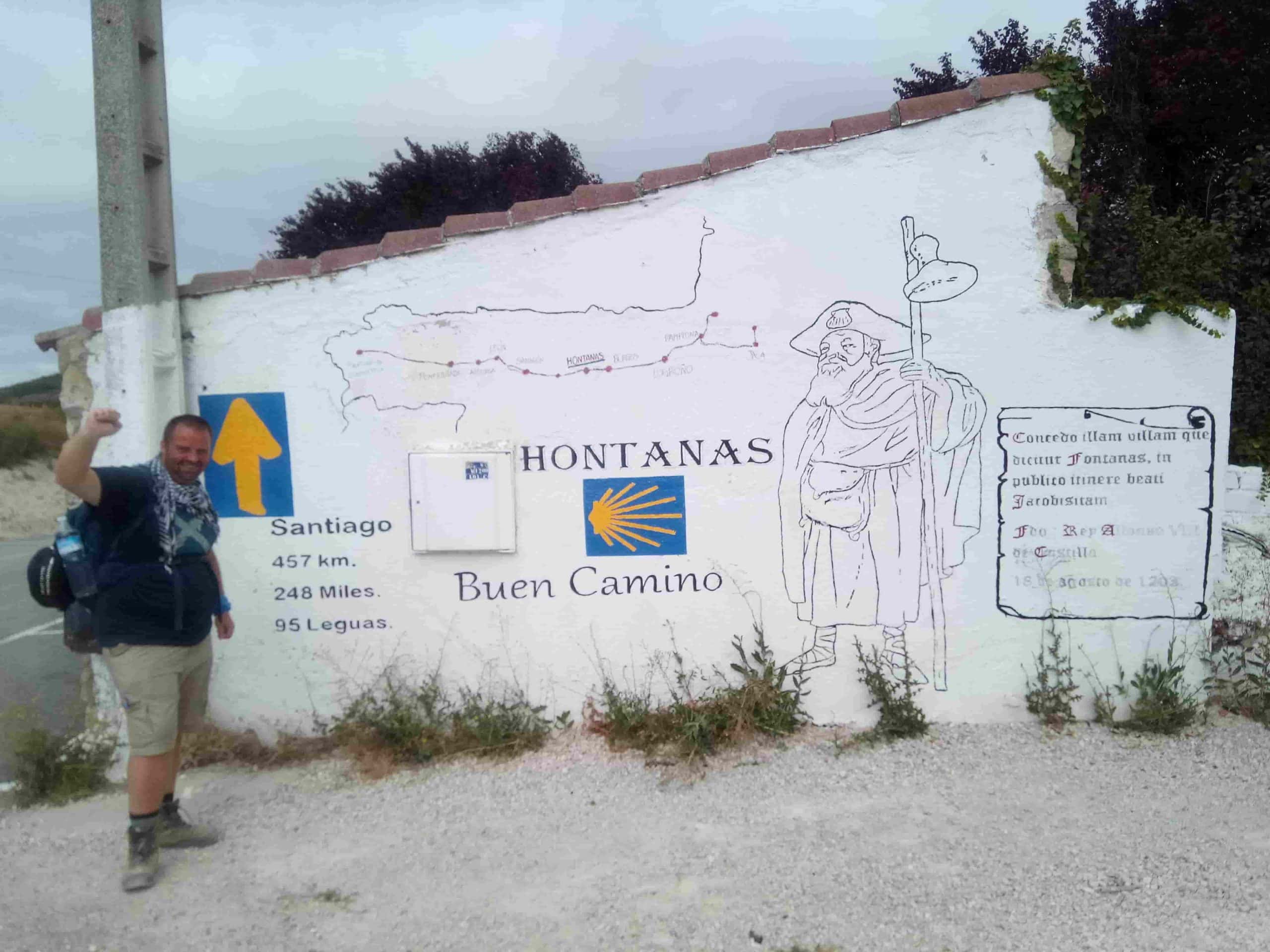
The yellow arrows are the navigation system of the Camino — painted on walls, trees, stones, kerbs, the sides of buildings. Wherever you are, however lost you feel, there is usually a yellow arrow. You follow the arrow. That is all. You do not need to know the whole route. You do not need to have walked it before. You need to be able to see the next arrow from where you are standing.
I think about the yellow arrows a lot, in coaching conversations. The question most people bring to coaching is not really where do I end up — they usually have some version of that. The real question is how do I move forward when I cannot see the whole path? The answer is the same on the Camino as it is anywhere: you find the next arrow. You take the next step. You trust that the step after that will become visible once you have moved.
The comfort zone does not disappear on the Camino. But somewhere around day thirty, you stop being as interested in its opinion. You have walked further than you thought you could. You have handled more than you expected to handle. And the quiet realisation that arrives, usually without announcement, is that the limits you had assumed were fixed were never really fixed at all.
They were just untested.
Where have you been holding back because you could not see the whole path?