Coaching & Mindset
The Confectionery Round
7 August 2026 · Jamie Wallace · self-knowledge · entrepreneurship · identity · coaching
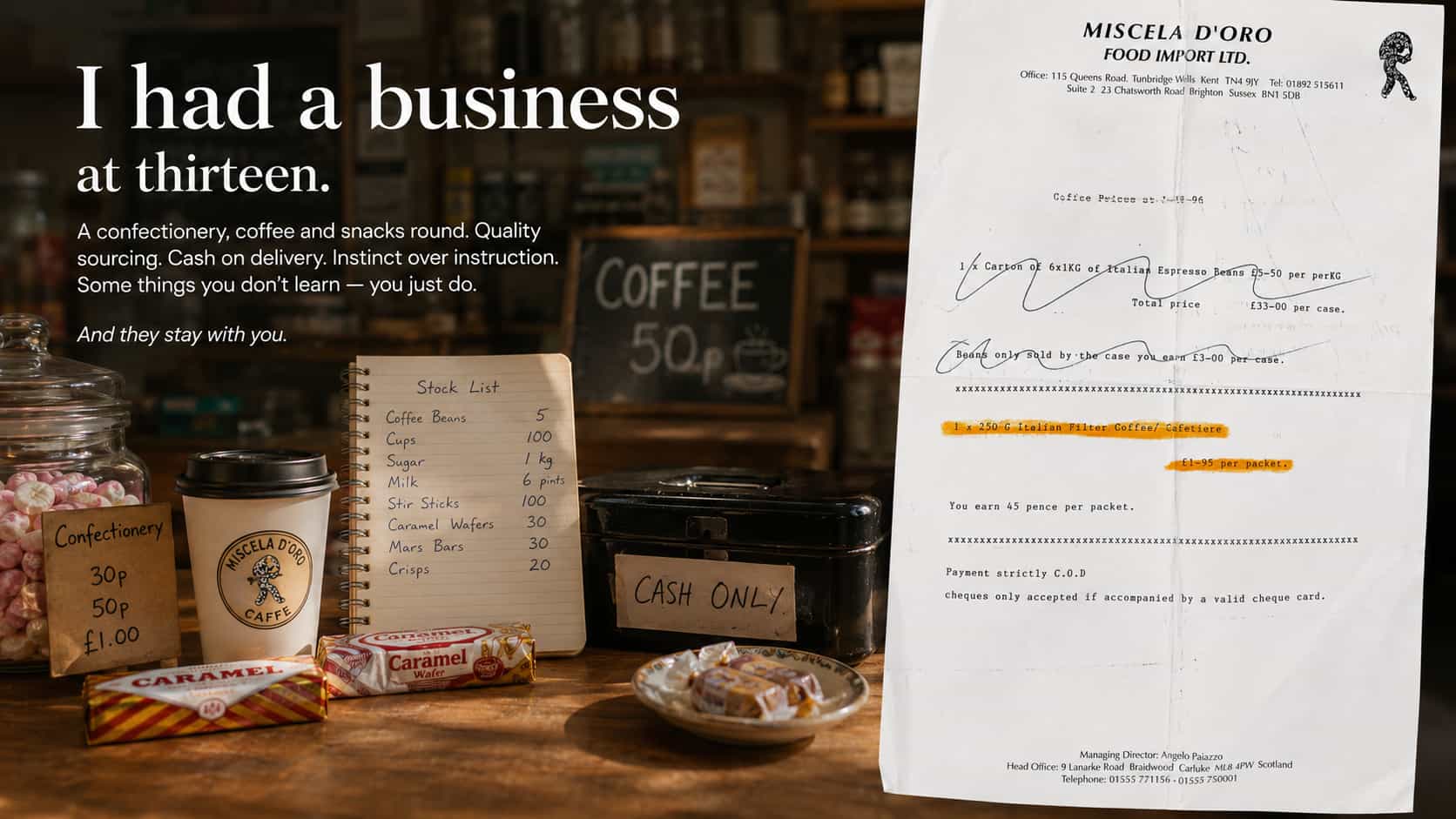
I was thirteen years old, and I had a business.
Not a lemonade stand. Not a car boot sale table with my parents standing three feet away. A proper operation: a confectionery, coffee and snacks round serving approximately fifty customers, run out of Lesmahagow, with a sourcing arrangement I was quietly proud of. The coffee beans came from Miscela d’Oro — an Italian supplier, because I had decided that was the standard I wanted. Payment was strictly cash on delivery. No exceptions.
I am not sure thirteen-year-old me would have used the phrase cash on delivery. But that was the policy.
I ran that round for long enough that it felt normal — the early starts, the logistics of supply, the ongoing negotiation between what customers wanted and what I could source, the satisfaction of a round that worked. And then, as these things do, life moved on. Secondary school became more demanding. Other things competed for the time. The business wound down.
And I forgot about it for about twenty-five years.
What I mean is: I did not forget that it happened. I remembered it the way you remember most childhood things — as a story, slightly fond, slightly distant, categorised as before I knew anything. It did not occur to me that it was evidence of anything. It did not occur to me that the instincts I had at thirteen — the sourcing judgement, the operational thinking, the complete comfort with the idea of running a small enterprise — were not things I had acquired since. They were things I had always had.
This is one of the quieter and more useful things that coaching surfaces, in my experience: not new capabilities but old ones, waiting to be recognised.
We have a habit — understandable, not always helpful — of treating our adult selves as the real version and our younger selves as the draft. Everything before some imagined point of maturity is preliminary. The adult self is the one that counts. The child who ran the confectionery round was just practising, just playing, just being young in ways that have no bearing on the serious business of being grown up.
But the instincts were real. The orientation was real. The thirteen-year-old who decided that Italian coffee beans were the right standard — who thought about quality and sourcing at an age when most of his peers were thinking about other things entirely — was not doing something that would later stop being true about him. He was doing something that would remain true about him for the rest of his life, whether or not he ever acknowledged it.
I find this particularly important with clients who describe themselves as having fallen into their career, or as having no idea what they actually want, or as feeling that they have lost the thread of who they are somewhere in the years of sensible decisions and practical compromises.
The thread is almost never lost. It is usually just unexamined.
The question I come back to, in those conversations, is something like: what were you doing at eleven or twelve or thirteen that felt completely natural — that you did not think of as a talent or a capability, because it was just how you were?
The answers are usually surprising. Sometimes they are surprising to the person giving them. And they almost always point toward something that is still true, still present, still available — if they choose to look at it that way.
The confectionery round was not the point. The point was the instinct behind it: the interest in quality, the comfort with enterprise, the straightforward assumption that if you wanted something done properly you organised it yourself. Those instincts led, eventually and by a circuitous route, to here — a coaching practice, a publishing house, a commitment to doing things at the standard I think they deserve.
I did not acquire those instincts in adulthood. I carried them from Lesmahagow.
There is a useful exercise I sometimes use in coaching: the twelve-year-old audit. What were you drawn to? What came naturally? What did you do without being asked, or keep doing even when it was inconvenient? The answers tend to describe a person more accurately than any personality test or competency framework I have encountered.
Your instincts were not naive. They were early.
What did you do at twelve that still tells you something true about who you are?